Collaboration between FEB UNNES and BPP West Ungaran: Young Farmers in Branjang Village Create Sustainable Agriculture with Organic Fertilizers to Support SDGs 12
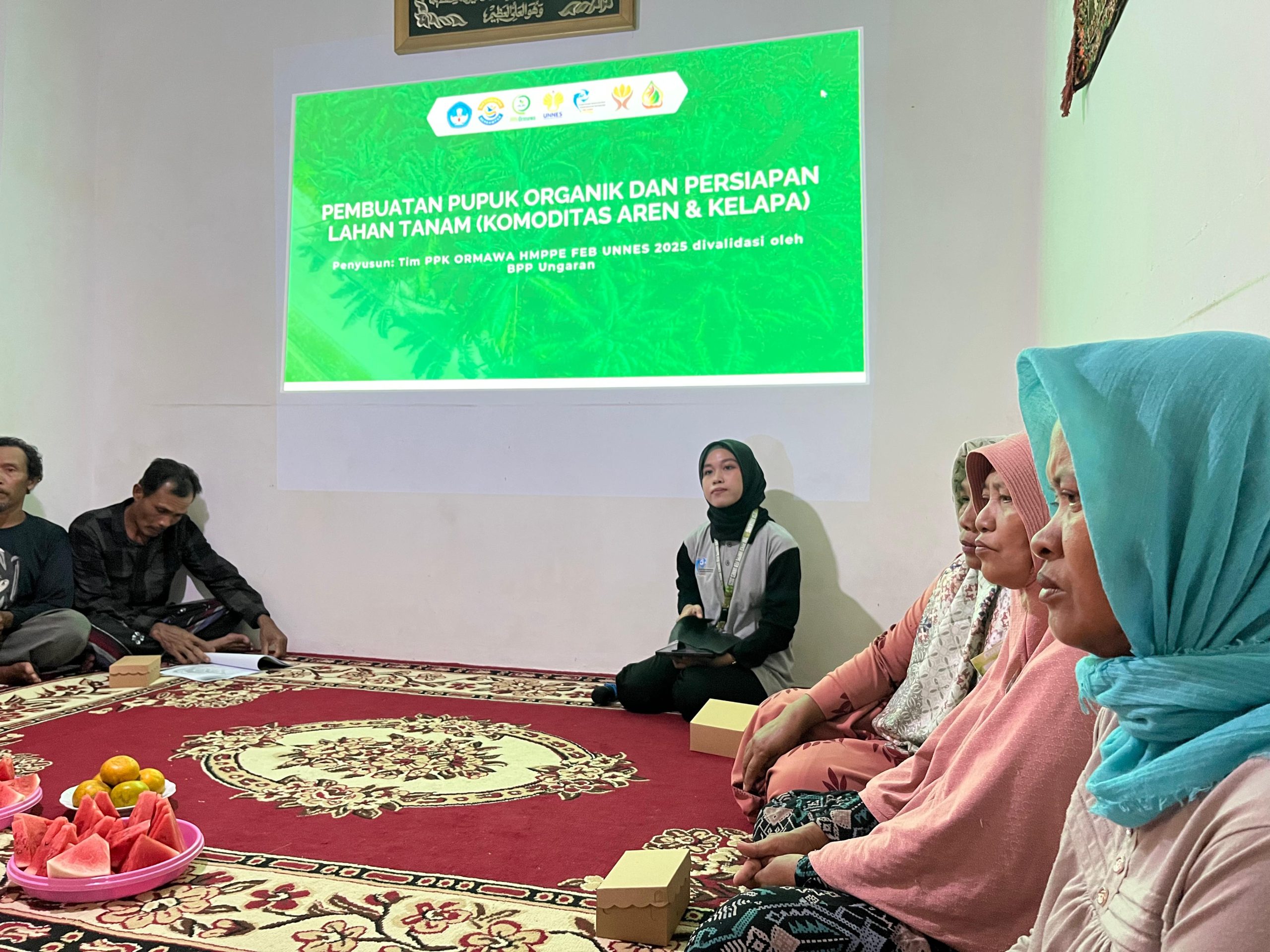
Branjang Village, August 29, 2025 – A significant step in supporting the development of modern and environmentally friendly agribusiness carried out by the PPK Ormawa team of the Student Association of the Economics Education Study Program, Faculty of Economics and Business, State University of Semarang together with the Gading Mayang Farmers Studio through training in making organic fertilizers from cow dung. This activity took place at Mrs. Srianah’s residence, Cemanggah Kidul Hamlet, Branjang Village, West Ungaran District, Semarang Regency, Central Java as the Secretary of the Gading Mayang Farmers Studio PPK Ormawa HMPPE FEB UNNES and with full support from the village apparatus and the Agricultural Extension Center (BPP).
The training, which was held on Friday, August 29, 2025, also aims to increase food security and reduce hunger through the empowerment of local farmers. By processing livestock waste into high-quality organic fertilizers, this activity helps to increase soil fertility and support optimal plant growth, which has a direct impact on agricultural productivity. In addition, this activity also supports SDG 12: Responsible Consumption and Production, by promoting the efficient use of resources and reducing dependence on chemical fertilizers that can damage the environment. Members of the Gading Mayang Farmers Studio can learn firsthand the process of processing livestock waste that has the potential to pollute the environment into high-quality organic fertilizers and as an effort to empower young farmers to become agents of change who are able to overcome dependence on chemical fertilizers. In the training, students are invited to get to know and practice making organic fertilizer using cow manure waste that has not been used optimally. With proper treatment, this waste is not only environmentally friendly but also has high economic value to improve soil fertility.
Muhadi S.Tr. P, as a speaker or resource person from the Branjang assisted Village Agricultural Extension Agency, explained that the use of organic fertilizers is a long-term solution for sustainable agriculture. “This organic fertilizer contains important nutrients that palm and coconut plants need to thrive. In addition, the correct manufacturing process and composting techniques will ensure that this fertilizer is of high quality and safe for the environment,” he said. In addition, Teguh Hardi Raharjo, M.Pd., the supervisor of PPK Ormawa HMPPE FEB UNNES, also accompanied the training process. He conveyed the importance of implementing the use of organic fertilizers in order to maintain the balance of the agricultural ecosystem. “This training is a tangible form of synergy between academics, the government, and the community to create sustainable agriculture,” he added. The success story in Sumberagung Village, Malang, is an inspiring example, where farmers have succeeded in reducing waste and optimizing the use of livestock waste to produce organic fertilizers. This similar program in Sumberagung Village not only increases agricultural yields but also supports the sustainability of the village environment and economy. The real impact for Branjang Village is an increase in agricultural yields, savings in production costs for farmers, and the creation of a more environmentally friendly agricultural system. These successes show that through collaboration between communities, governments, and academia, sustainable and environmentally friendly agriculture can be realized, in line with the global goal of reducing hunger and creating more responsible consumption and production patterns.