Semarang — The Student Creativity Program for Exact Research (PKM-RE) team from the Faculty of Mathematics and Natural Sciences (FMIPA) of Semarang State University (UNNES) has successfully developed ChitoGreen, an innovative, environmentally friendly bioplastic made from chitosan derived from milkfish (Chanos chanos) scales and moringa (Moringa oleifera) leaf starch.
The research, titled “Innovation of Chitosan Bioplastic from Milkfish Scales and Moringa Leaf Starch with Natural Deep Eutectic Solvent Extraction as Environmentally Friendly Packaging,” was carried out by Berlian Avicenna (Environmental Science) as team leader, with members Wildan Aroffi (Chemistry), Rifqi Ardiyansyah (Science Education), and Romadoni (Science Education). The project was supervised by Fidia Fibriana, S.Si., M.Sc., Ph.D., a lecturer at FMIPA UNNES.
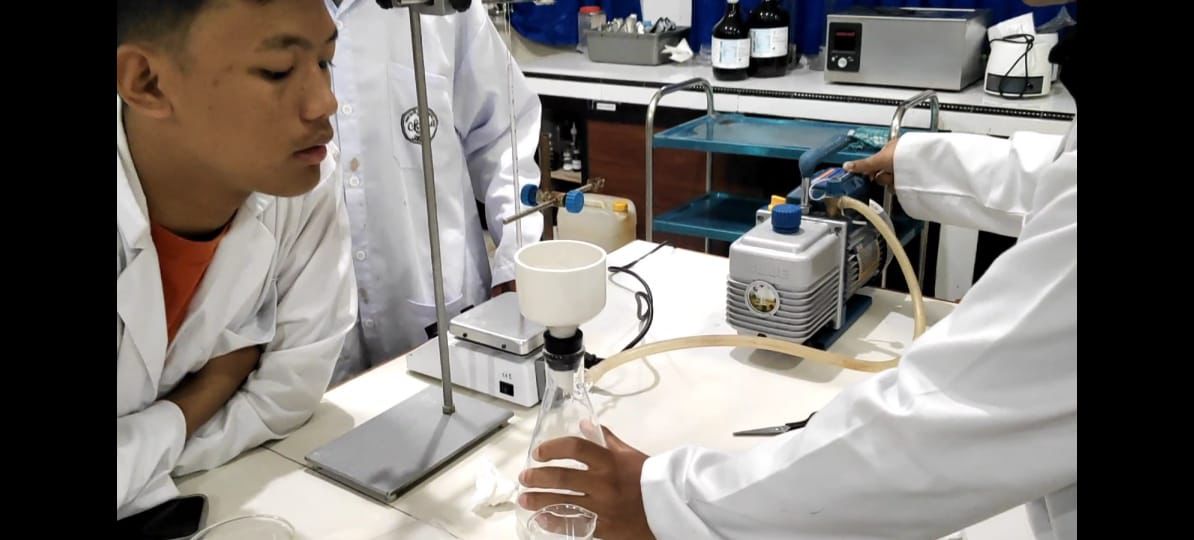
Through this research, the ChitoGreen team seeks to transform organic fishery waste into high-value, sustainable materials that can serve as substitutes for conventional plastics. The chitosan extraction process employs the Natural Deep Eutectic Solvent (NADES) method, a green chemistry approach that minimizes environmental impact compared to traditional chemical solvents.
According to Berlian Avicenna, the team’s leader, utilizing waste from milkfish and moringa leaves represents a tangible effort by UNNES students to promote a circular economy and reduce single-use plastic pollution.
“We hope this innovation can inspire others to see that natural materials around us can be transformed into sustainable products that are beneficial for the environment,” said Berlian.
The resulting bioplastic, named ChitoGreen, exhibits a yellowish-transparent, elastic texture and is biodegradable, making it suitable for eco-friendly food packaging. The team conducted comprehensive tests on tensile strength, biodegradability, solubility, and antimicrobial activity against Escherichia coli and Staphylococcus aureus.
This research was funded by the Directorate General of Higher Education, Research, and Technology (Kemendikbudristek) through the PKM-RE 2025 scheme, serving as a real example of how UNNES students apply scientific knowledge to produce innovations that contribute to sustainable development.
Aligned with the Sustainable Development Goals (SDGs), this project strongly supports:
- SDG 9: Industry, Innovation, and Infrastructure, by encouraging research-based innovation in sustainable materials.
- SDG 12: Responsible Consumption and Production, through the development of eco-friendly materials that reduce environmental impact.
- SDG 14: Life Below Water, by minimizing plastic waste pollution originating from human activities.
Through the ChitoGreen innovation, UNNES continues to demonstrate its commitment as a Conservation University that fosters environmentally conscious research, empowering students to be agents of change toward a sustainable future.