In life’s journey, people often become preoccupied with the past or anxious about the future—forgetting to be fully present in the moment.
Yet, the ability to remain calm and aware of oneself and one’s situation is the essence of mindfulness, a crucial aspect of self-compassion. Through mindfulness, individuals learn to recognize emotions, respond consciously, and nurture inner peace.
However, for many elderly individuals, such awareness does not come easily. Aging often brings physical changes, loss of loved ones, and feelings of helplessness—factors that can lead to restlessness, irritability, or even destructive emotional outbursts.
Arising from this concern, a team from the Student Creativity Program – Community Service (PKM-PM) at Universitas Negeri Semarang (UNNES) initiated an innovative program titled “Wening Ati”, which means calm heart. The team consists of Pradana Satriya Utomo, Disrun Aji Prabowo, Walda Mu’tia Sari, Sandya Sarira Ayu, Muhammad Wafi Bahauddin Aiz, under the supervision of Yogi Swaraswati, S.Psi., M.Si.
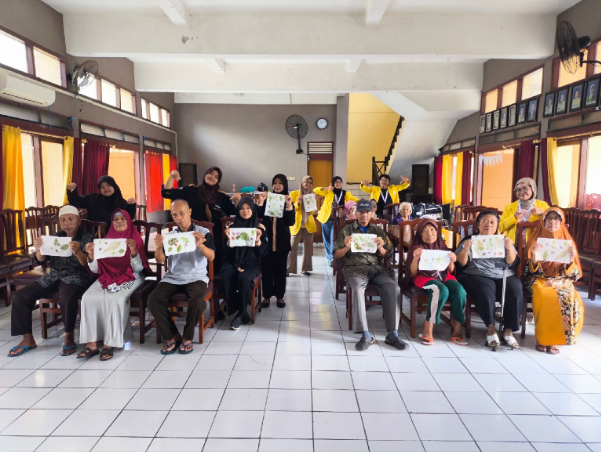
Through a mindfulness-based approach, the program invites elderly participants to reconnect with themselves through two reflective activities: emotion regulation through ecoprint art and relaxation training using deep breathing and the butterfly hug technique.
During the relaxation sessions, participants are guided into a state of calmness—slowly inhaling and exhaling, feeling the rhythm of their breath, and gently embracing themselves through the butterfly hug movement.
This simple technique helps them rediscover inner tranquility and realize that peace can be cultivated from within.
Meanwhile, in the ecoprint activity, participants express their emotions through patterns and colors of leaves imprinted on fabric—a creative yet therapeutic method for emotional regulation.
One of the participants, Mbah Maria, shared that deep breathing and the butterfly hug have helped her feel calmer and improved her sleep quality.
Another participant, Mbah Eka, added that the same techniques are very effective in helping her manage stress and pressure.
Both activities serve as practical mindfulness exercises that allow elderly participants to be present and aware of every breath, feeling, and response they experience. From this process emerges a sense of acceptance, peace, and self-presence—gently restoring their emotional balance and well-being.