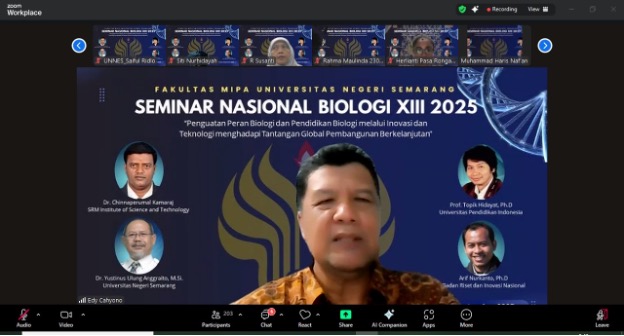
The Biology and Biology Education Study Programs of the Faculty of Mathematics and Natural Sciences (FMIPA), Universitas Negeri Semarang (UNNES), successfully hosted the 2025 National Biology Seminar (SNB) on Thursday, 25 September 2025. Carrying the theme “Strengthening the Role of Biology and Biology Education through Innovation and Technology in Facing the Global Challenges of Sustainable Development,” this event served as a significant academic platform to promote collaboration, innovation, and the integration of sustainability values in biological sciences and education.
Led by Dr. Lina Herlina, M.Si., as the committee chair, SNB 2025 featured distinguished speakers from both national and international institutions, including Prof. Topik Hidayat, M.Si., Ph.D. (Universitas Pendidikan Indonesia), Dr. Chinnaperumal Kamaraj, Ph.D. (SRM Institute of Science and Technology, India), Dr. Arif Nurkanto, S.Si., M.Si., Ph.D. (National Research and Innovation Agency – BRIN), and Dr. Yustinus Ulung Anggraito, M.Si. (Universitas Negeri Semarang).
In his opening remarks, the Dean of FMIPA UNNES emphasized the urgency of cross-institutional collaboration and knowledge exchange in the era of globalization. He stated, “By sharing ideas and scientific advancements, we can expand our insights into the use of technology in research and education, ensuring that our innovations bring tangible benefits to society and support sustainable progress in every sector.”
The seminar included a plenary session featuring keynote speakers and parallel sessions involving presenters from nine provinces across Indonesia—Aceh, Jambi, the Riau Islands, East Kalimantan, North Sulawesi, Riau, West Java, Central Java, East Java, and West Papua. Participants consisted of researchers, educators, teachers, and students, all united by a shared vision of advancing biological science and education for sustainability.
Research topics presented during SNB 2025 spanned diverse areas such as biotechnology and microbiology, zoology and health, and botany and environmental studies, demonstrating the close connection between biology and sustainable development. These scientific efforts contribute directly to several Sustainable Development Goals (SDGs), particularly SDG 4 (Quality Education), SDG 13 (Climate Action), SDG 15 (Life on Land), and SDG 3 (Good Health and Well-being).
By bridging biological research and education with the SDG framework, SNB 2025 underscored the essential role of innovation and technology in addressing global environmental and health challenges. Discussions emphasized the importance of developing sustainable biological solutions, conserving biodiversity, and fostering eco-conscious education—reinforcing UNNES’s commitment as a Conservation University dedicated to sustainability science and community empowerment.
Through this agenda, held on 25 September 2025, UNNES reaffirmed its commitment to advancing scientific knowledge that is impactful, inclusive, and sustainable. The National Biology Seminar 2025 not only strengthened academic collaboration but also became a catalyst for integrating biological sciences with the 2030 Sustainable Development Agenda, ensuring that future generations of biologists and educators are equipped to lead transformative change for a greener, healthier, and more sustainable planet.