

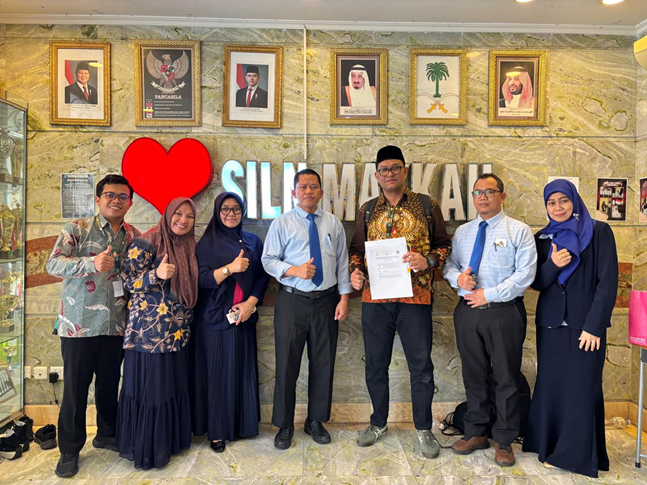
Makkah, October 27, 2025 — The Faculty of Education and Psychology (FIPP) of Universitas Negeri Semarang (UNNES) successfully carried out an international community service program titled “Digital Interactive Parenting (DIP) to Enhance the Flourishing of Immigrant Parents at Sekolah Indonesia Mekkah.”
The program was led by Farid Ahmadi, S.Kom., M.Kom., Ph.D, Vice Dean I for Academic and and Student Affairs of FIPP UNNES, alongside team members Achmad Miftachul ‘Ilmi, S.Pd., M.Pd., Dr. Wulan Aulia Azizah, S.Pd., M.Pd., Elok Fariha Sari, S.Pd.Si., M.Pd., and Fitria Dwi Prasetyaningtyas, S.Pd., M.Pd. The program also involved an external partner, Mustafa, Head of Sekolah Indonesia Mekkah, Saudi Arabia.
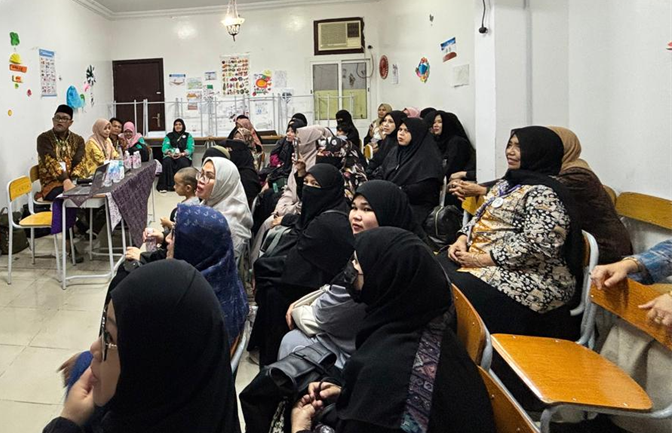
The Digital Interactive Parenting (DIP) program was designed as a form of mentoring and empowerment for immigrant parents to help them develop positive parenting skills in the digital era. Through an interactive approach based on technology and Indonesian family values, this initiative aims to promote flourishing—which encompasses happiness, psychological well-being, and positive parent–child relationships within transnational family contexts.
In his remarks, Farid Ahmadi, S.Kom., M.Kom., Ph.D, emphasized that this program represents a tangible implementation of UNNES’s vision as a Conservation University with International Reputation, actively contributing to the social impact of education at the global level.
“Through this program, we aim to introduce an adaptive and sustainable parenting approach that integrates local wisdom with digital technology, ensuring that immigrant parents can continue to nurture their children’s growth and development effectively,” said Farid Ahmadi, S.Kom., M.Kom., Ph.D.
The activity featured interactive training sessions, reflective discussions, and simulations of character-based digital parenting practices. Participants—who were parents of students from Sekolah Indonesia Mekkah—enthusiastically welcomed the program, stating that DIP provided them with new insights into balancing technology use, family communication, and spiritual values in child-rearing. Beyond its social and educational impact, the program also contributes to the achievement of the Sustainable Development Goals (SDGs), particularly SDG 3 (Good Health and Well-Being), SDG 4 (Quality Education), and SDG 17 (Partnerships for the Goals), through synergistic collaboration between Indonesian higher education institutions and overseas educational organizations.