UNNES and Monash University Strengthen Global Research Collaboration on Sense of Belonging and Student Well-Being

Universitas Negeri Semarang/Faculty of Education and Psychology/Berita/UNNES and Monash University Strengthen Global Research Collaboration on Sense of Belonging and Student Well-Being

Clayton, Melbourne – October 7, 2025.

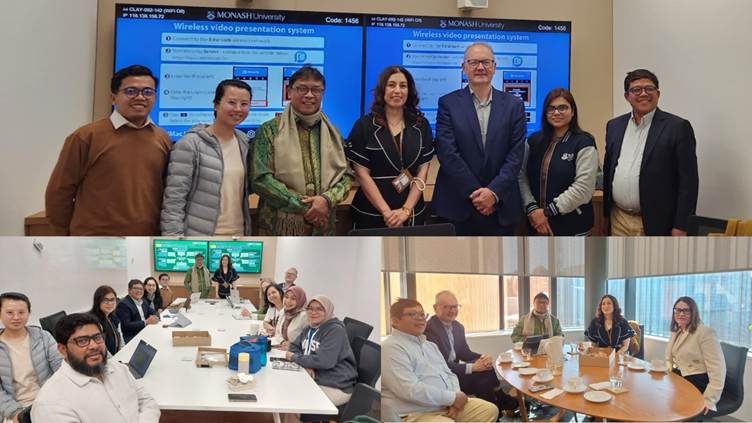
The research team from Universitas Negeri Semarang (UNNES) conducted a visiting program and guest lecture at the Faculty of Education, Monash University, Australia. This initiative marked an important step in strengthening international research collaboration and developing evidence-based policies in the fields of sense of belonging and student well-being within higher education contexts.

The UNNES research team consisted of Prof. Dr. Edy Purwanto, M.Si., Ali Formen, S.Pd., M.Ed., Ph.D., Rahmawati Prihastuty, S.Psi., M.Si., Yuli Kurniawati Sugiyo Pranoto, S.Psi., M.A., D.Sc., and Achmad Miftachul ’Ilmi, S.Pd., M.Pd. The team was warmly welcomed by Associate Professor Kelly-Ann Allen, Ph.D. (research collaborator from Monash University), Professor Mary Ryan, Ph.D. (Dean of the Faculty of Education, Monash University), and Professor Lindsay Oades, Ph.D. (Deputy Dean and Professor of Wellbeing Science from the University of Melbourne), who also joined as a partner in the field of well-being science. The issue of student well-being, as emphasized during the visit, is crucial to be continuously advocated not only in the context of academic achievement but also as a fundamental pillar for realizing the broader goals of sustainable development (Sustainable Development Goals) as a whole.

The program began with a welcoming address by Assoc. Prof. Kelly-Ann Allen at the Learning & Teaching Building, Monash Clayton Campus, followed by a guest lecture delivered by Prof. Dr. Edy Purwanto in Room 1-142. The session, attended by Monash University Master’s and Ph.D. students, discussed the topic “Evidence-based Policy Recommendations to Improve Students’ Sense of Belonging and Well-Being.” In his presentation, Prof. Edy shared the results of a collaborative study involving several Indonesian teacher education universities, highlighting that sense of belonging and student well-being are foundational elements of students’ motivation, resilience, and academic success. The study also underlined the need for data-driven campus policies, the strengthening of faculty-based psychological services, and the development of an inclusive and mentally healthy academic culture.

Following the lecture, the UNNES research team held a strategic discussion with Professor Mary Ryan and Professor Lindsay Oades at the Dean’s Office, Faculty of Education, Monash University. The meeting focused on future collaborative research plans among UNNES, Monash University, and the University of Melbourne, including the development of policy briefs for Indonesian universities, the design of policy models to enhance students’ sense of belonging, and opportunities for academic exchange and joint publication. The program concluded with a campus tour around Monash University’s Walk of Fame and Central Green area.

During the event, Prof. Dr. Edy Purwanto emphasized that this collaboration reflects UNNES’s strong commitment to advancing higher education policies centered on student well-being.

“We believe that students’ well-being and sense of belonging to their university are the foundation of academic success. This collaborative research represents a concrete effort to build a higher education ecosystem that is more humane and sustainable,” he stated.

Meanwhile, Associate Professor Kelly-Ann Allen highlighted the importance of cross-country collaboration in addressing global student well-being issues.

“The UNNES team brings a rich and contextual perspective from Indonesia. Together, we can develop policies and practices that enhance student well-being around the world,” she said. This visiting and guest lecture program stands as a concrete step by UNNES toward realizing its vision as a University with Conservation Insight and International Reputation, through evidence-based research and policy initiatives that promote student well-being and strengthen an inclusive, adaptive, and sustainable academic culture at the global level.
Related Posts

Leave a Reply

* Kode Akses Komentar:

* Tuliskan kode akses komentar diatas:

GDPR

  • Privacy Policy

Privacy Policy

At unnes.ac.id, the privacy of our visitors is of extreme importance to us. This privacy policy document outlines the types of personal information that is received and collected by unnes.ac.id and how it is used.

Log Files

Like many other Web sites, unnes.ac.id makes use of log files. The information inside the log files includes internet protocol (IP) addresses, type of browser, Internet Service Provider (ISP), date/time stamp, referring/exit pages, and number of clicks to analyze trends, administer the site, track user’s movement around the site, and gather demographic information. IP addresses and other such information are not linked to any information that is personally identifiable.

Cookies

unnes.ac.id uses cookies to store information about visitors’ preferences, to record user-specific information on which pages the site visitor accesses or visits, and to personalize or customize our web page content based upon visitors’ browser type or other information that the visitor sends via their browser.

Third-party ad servers or ad networks use technology in their respective advertisements and links that appear on unnes.ac.id and which are sent directly to your browser. They automatically receive your IP address when this occurs. Other technologies (such as cookies, JavaScript, or Web Beacons) may also be used by our site’s third-party ad networks to measure the effectiveness of their advertising campaigns and/or to personalize the advertising content that you see on the site.

unnes.ac.id has no access to or control over these cookies that are used by third-party advertisers.

You should consult the respective privacy policies of these third-party ad servers for more detailed information on their practices as well as for instructions about how to opt-out of certain practices. unnes.ac.id’s privacy policy does not apply to, and we cannot control the activities of, such other advertisers or web sites.

If you wish to disable cookies, you may do so through your individual browser options. More detailed information about cookie management with specific web browsers can be found at the browsers’ respective websites.

Consent

By using our website, you hereby consent to our privacy policy and agree to its terms.

Update

This Privacy Policy was last updated on: 2023-02-14. Should we update, amend or make any changes to our privacy policy, those changes will be posted here.

Contact Us

If you have any questions, comments, or concerns about our Privacy Policy or our practices with regards to your personal information, please feel free to contact us through the contact form on our website or by emailing us at humas[at]mail.unnes.ac.id.

This Privacy Policy is intended as a general guide to our practices in collecting and using information. If there is any inconsistency between this Privacy Policy and the terms of the Service Agreement or any other terms that may apply to specific services you use, then those specific service terms shall apply.

Terms of Use

By using our website, you agree to abide by this Privacy Policy. If you do not agree with this Privacy Policy, please do not use our website. We reserve the right to update this Privacy Policy from time to time without prior notice. Please review our Privacy Policy periodically to check for changes. Your continued use of our website following the posting of changes to this Privacy Policy means that you accept the changes.

Thank you for reading our Privacy Policy. We are committed to protecting the privacy of our website visitors and will continue to update our Privacy Policy to ensure optimal protection.